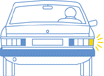
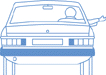
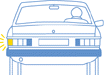
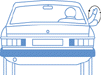
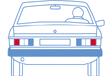
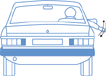
Signals by drivers (include riders of motor cycles and motor tricycles) and cyclists to other road users
You should give signals when this would help or warn other road users. Give only the correct signals - those illustrated - and only for the purposes described. Give them clearly and in good time. Always be sure that your direction indicator signal is cancelled after a manoeuvre.
Arm signals are for use when direction indicator signals are not used; or when necessary to reinforce direction indicator signals and stop lights. They are also for use by pedal cyclists.
You should only give signals to indicate your intentions to other road users. Never use them as instructions.
Do not drive or ride on the road until you know how to signal properly and what other peopleʼs signals mean.
Stop lights are red lights which come on at the rear of the vehicle when the driver puts on the brakes. They tell the following road users that the vehicle is slowing down or stopping. They must not be confused with the rear lights which are also red.
Horns are used only for warning any person on or near a road of danger. Never use them for any other reason.
Headlamp flashing is also a warning to other road users.
Bells are used by pedalcyclists as a warning.
|
Signals by police officers and other authorised persons
Signals given by a policeofficer, traffic warden, or other authorised person (for example, the authorised personnel at tunnel areas orcontrol areas, or school crossing patrols) take precedence over all traffic signs, road markings and traffic light signals. Use your common sense before relying on signals given by any other person.
At junctions when all traffic is stopped by police officers or traffic wardens, you must not filter to the left or right until they signal you to do so.
Two-tone horns and sirens, white, red or blue flashing lights are used by ambulances, fire engines, police and other authorized organisations in emergencies to warn of their presence and signal their right-of-way. Drivers must give way to emergency vehicles signaling their right-of-way.
|
Signals